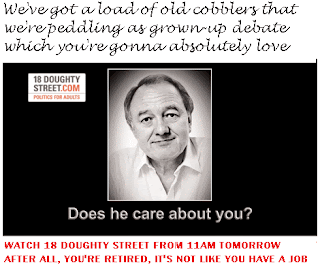
I want to talk about Iain Dale and 18 Doughty Street.
Two of their campaigns really get my goat - the anti Ken Livingstone drive and the anti-state funding drive.
I'm not going into the details of Iain Dale's Ken Livingstone
campaign, read
this from Tim Ireland, which sets it out perfectly. In short: Ireland criticises Dale for his coverage of the Smith Institute/Sith (delete as politically relevant), because Iain Dale is a trustee of Policy Exchange; Policy Exchange being the Tory's version of the S(m)ith - a registered charity with a party political slant. Iain Dale is a trustee of the Policy Exchange. So is Nick Boles. Who has
applied to be Mayor of London. See the connection? 18 Doughty Street don't... and haven't made any declaration of interest. "Politics for adults" turns out to be not much more than a, well,
Fox News Lite.
The issue here is most definitely declarations of interest. Or rather the lack of.
Which leads me onto the Dale/18DS state funding campaign.
18DS's next attack ad is on Livingstone. The
last was on State Funding. In it, three MPs from the major parties discuss a forthcoming election. (You can tell which party they're from - they have coloured rosettes: it might be politics for adults, but it's not politics for particularly bright adults) Anyway, they sit in a suitably swanky restaurant and discuss how to swindle the costs of the next election out of the British Public, while at the same time inferring that they are pocketting the cash and planning to emigrate. Not exactly a reasoned argument. Not exactly "politics for adults".
What the ad doesn't mention is another of Dale's undeclared interests: that
immediately before his last election campaign,
his constituency association received generous funding from Lord Ashcroft. This was legal and in no way breached electoral law. Nevertheless, between the time that Iain Dale was selected as a Potential Parliamentary Candidate and the calling of the 2005 General Election, Iain Dale's constituency assocation was funded by a millionaire who applied an unprecedented level of financial leverage to a UK General Election Campaign: a feat he would be unable to repeat in a state-funded environment.
This is a pertinent and important fact and shapes any interpretation that can fairly be made of Iain Dale's campaign against State Funding. Needless to say, he doesn't mention it.
At the last election, Iain Dale stood in North Norfolk for the Conservatives. His was one of the constituencies chosen to be funded by Lord Ashcroft's Bearwood Corporate Services.
Now if you're not familiar with Lord Ashcroft, the biog is something like this (better be careful, he's somewhat
litigious): brought up in UK and Belize, makes
millions, donates
millions to Tory Party. Offered a peerage by William Hague in 2001 on the condition that he took British citizenship (he had uncharitably been
dubbed a "tax exile" up to that point) Ashcroft
quipped back "only if I can be titled Lord Ashcroft of Belize".
His support for the Conservative Party during the 2005 General Election was unusual: Ashcroft chose the seats into which the money was donated.
One of which was Iain Dale's North Norfolk campaign.
I raised this with Dale last week, and he
made some valid points (at 5.27 and 5.59), particularly in correcting me that the money was not direct campaign funding, but that it was donated before the campaign - i.e before Parliament dissolved for the election.
He made some weaker points too: on Ashcroft's procedure for selecting the seats he would support, he
said (5.40pm):
The seats were analysed according to which seats needed the most support. Seats which had adequate funding did not receive any. All candidates had to submit a properly costed business/campaign plan and they were analysed on that basis.This is pretty unlikely, not least because the
Cities of London and Westminster - one of the richest constituencies in Western Europe and true blue since time immemorial - was also Ashcroft/Bearwood funded. It also contradicts the evidence
given by Peter Bradley at the Constitutional Affairs select committee hearing into party funding in 2005 (although as a Labour MP unseated by Tory using Bearwood funding, I accept that he's hardly a disinterested observer):
(Bearwood and others using the same method) contributed over £1.3 million to what I have identified as three categories of constituency:
— those Labour and Liberal Democrat seats they aimed to win in 2005;
— those Labour and LD seats they aim to win at the next election; and
— Conservative marginals they were defending in 2005.Dale went
on "
He bypassed CCO because he rightly thought that the money would be wasted."
Aside from the fact that a Tory PPC thinks a donation to the Tory party would be a "waste", I think Dale's comment here is the biggest indictment of the Bearwood model.
Why should a millionaire dictate how parties are run? Who were the voters of Norfolk North (or the Cities of London and Westminster, or any of the other dozens of constituencies that Bearwood and others funded) actually voting for - the Conservative candidate or the Bearwood candidate? To whom do they look to for representation? To whom does the candidate look to for direction - his party or his funder? What is the point of political parties at all if they are simply used as a vehicle to further the political opinions of the super-rich?
This pattern will continue. According to Lord Ashcroft, the results of the 2005 General Election funding model were pleasing:
"it soon became clear that we had been wasting neither our time nor our resources. Of the 33 candidates who won seats from Labour or the LDs, no fewer than 25 had received support from the fund that I had set up"
(Lord Ashcroft, "Dirty Politics, Dirty Times", p.295-6)
So, in other words, expect more of the same. A lot more.
State funding is a deeply flawed option. It will almost certainly be criticised for costing too much. It will take funds away from elsewhere. It will require civil servants to implement it. It will, no doubt, be inefficient at some point in its implementation. And, sin of sins, it may need to be paid for out of tax. But it is the least worst option.
Critics of of state funding inevitably point to cash for peerages as an example of the venality of politics. But they miss the point: the cash for peerages scandal is what happens when you increase public scrutiny of the political system. Parties have always given their donors peerages (**looks up page**). It has come to light because it is only recently that it has been provable. We need more of this. State funding would give us more.
State funding would be the subject of unparalleled scrutiny precisely because it is so controversial. It would be a further illumination of one of the dark spaces of British politics.
On the other hand, more private funding = more private funders. More hidden agenda. More debasing of politics.
Whatever you think of state funding, remember that there are vested interests speaking vocally and that they aren't declaring those interests.
It is not as cut and dried as Iain Dale or 18 Doughty Street make out. Not by a long way.
***EDIT***
The Ken Livingstone attack
ad is now up on the 18DS website. The
link to it on Iain Dale's site is attracting some criticism of the "sources" used for the "facts", but no declaration of interest...
Picture my surprise.


